Showing posts with label Perennial flower. Show all posts

Monday, 24 September 2018

Tutti Frutti Butterfly Bush : Description and Planting information


                            Tutti Frutti Butterfly Bush 

'Tutti Frutti' Butterfly Bush is a dwarf variety and a shrub-like plant with striking purple coloured flower grows very quickly.The highly fragrant flowers attract butterflies and hummingbirds to the garden.A butterfly bush often can be seen with a mass of butterflies on the flowers, especially in afternoons. Buddleias attract other insects too, like moths, and the reddish ones strongly attract hummingbirds. So it is more than a name, it is actually a botanical phenomenon.

Common Name : Butterfly Bush Flutterby Petite

Botanical Name : Buddleia Flutterby Petite

Mature Height : 24-30" tall and 16-22" wide

Flower Color : Purple

Flower Size : 6-10" flowers

Foliage Color Green

Foliage: Bushy arching stems

Light Requirements : Full Sun/ half sun

Soil Type : Loamy Soil, Drought/Dry Soil

Advantages : Deer Resistant, Attract Butterflies, Attract Hummingbirds, Attract Birds, Rabbit Resistant, Easy to Grow, Fragrant

Planting Instructions :

In India Butterfly bushes grows well in winter. In the very cold places they die in the very starting. but in hot regions, they are evergreen. In the warmer states, butterfly bushes often grow to 24 to 30 inches high, and require pruning to keep them shapely. They're happy in almost any soil and prefer moist ground, but will also do well in dryer spots. They need plenty of sun, but will be fine with some shade in the warmer areas. All this tells you that this plant is a tough one, and should be easy to grow in your garden. A well-grown specimen can be a magnificent "fountain" of flowers, since the stems with heavy flower clusters tend to arch in all directions.

Planting steps :

Choose a warm place with well drained and acidic soil.
If weather cooperates begin planting as soon as possible. If not, keep butterfly bushes where they get some sun through a window, and keep them moist, not soggy.
As set out the potted butterfly bushes, dig to loosen the soil around and below the actual spot, and then set the rooted plant at the same level if was growing in the pot.
Plant butterfly bushes about 4-6' apart, depending on the variety.
When remove the plant from the pot, do not pull on the leaves or stems. Squeeze the pot a little and the roots and soil will slide out for you.
Water well after planting, and continue to water at least every two weeks, depending on rainfall.

Thursday, 20 September 2018

Hepatica Liverwort: Description


                                Hepatica Liverwort
One of the  most beautiful woodland wildflowers is Hepatica Liverwort.The mature plants are in height of 4-6" and 6-9" wide. The flower is the colour of  pink, blue and white. Some even take on a picotee coloring, with stunning white-edged purplish petals. The foliage colour is green. Three lobed leaves appear after blooms. Each plant is approximately the size of a healthy African violet. An easy-to-grow must-have species for all shady gardens. Some parts of the plants are poisonous or toxic to the animals if ingested.

Common Name : Hepatica, Liverwort

Botanical Name: Hepatica acutiloba

Light Requirements : Half Sun / Half Shade, Full Shade

Flower Color: Pink, Blue, White

Flower Size : 1" flowers

Mature Height : 4-6" tall

Foliage Color : Green

Soil Type  :Loamy Soil, Moist/Wet Soil, Acidic Soil

Advantages Bee Friendly, Native, Multiplies / Naturalizes


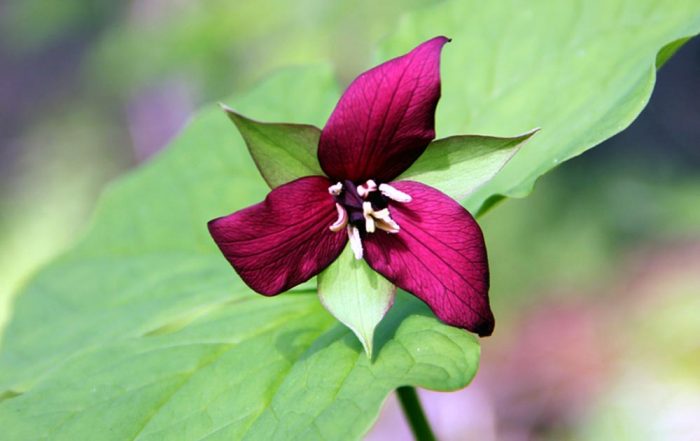
Red Trillium: Plant description & Propagation


                                      Red Trillium

One of the most famous members of the famous Trillium family, the Red (or Purple) Trillium is also known as Wake Robin. This beautiful wildflower is one of the easiest Trilliums to grow, since it is tolerant of acid or alkaline soils. The  blooms are up to 4 in. across, and held high above the leaves on upright plants to 16 in. tall.The foliage is slender green stalk with three large connected leaves. Blossoms leave a berry-like fruit. The flower has sometimes lemon flovour scent.Some parts of the plants are  poisonous or  toxic to the animals if ingested.

.
Common Name :Wake Robin, Stinking Benjamin, Purple Trillium

Botanical Name :Trillium erectum 

Flower Color : Red

Flower Size : 1-2" flowers 

Foliage Color : Green

Mature Height : 6-18" tall

Light Requirements : Half Sun / Half Shade, Full Shade

Soil Type : Loamy Soil, Moist/Wet Soil

Advantages : Deer Resistant, Rabbit Resistant, Fragrant, Native, Multiplies / Naturalizes

Propagation:

Trillium plants are propagated from seed. Trilliums such as The Great White spread very slowly by underground root stocks, and the seed produced creates new plants even more slowly. From a planted seed, it takes approximately five to nine years for a Trillium grandiflorum plant (the Great White Trillium) to bloom. So when you see a massive drift of these in spring,  looking at a bunch of plants that are at least a decade old, probably much older.


Indian Pink: Plant description & Planting


                                      Indian Pink

Indian Pink is kind of perennial vibrant red color flower.The unusual blooms are trumpet shaped with a red exterior, yellow inside, and a unique flare at the top that forms a star shape.Indian Pink is also known as woodland pinkroot. The plant is easy o grow and glossy green oval lance shaped foliage.


Common Name : Indian Pink

Botanical Name : Spigelia marilandica

Light Requirements :Half Sun / Half Shade, Full Shade

Flower Color : Red

Flower Size : 1-2" flowers

Mature Height : 12-18" tall

Foliage Color : Green

Soil Type : Loamy Soil, Drought/Dry Soil, Moist/Wet Soil

Advantages : Attract Hummingbirds, Easy to Grow, Native

Planting Depth : Plant so that the top of the root is 1" below the soil line.


Planting:

Its best to be planted in late summer or early fall to ensure summer blooms. It’s a favorite among butterflies and hummingbirds. Indian Pink should be planted along the wood edge or in a shaded garden. Its growing nature prefers neutral, well-drained soils.

Wednesday, 23 November 2016

Wisteria flower seed germination tips


Wisteria is the climbing tree for the English cottage garden. A good wisteria is an absolute joy in May and June when the beautiful, scented pendants of flowers drape from the branches in a breathtaking display. Most of the time the gardeners find these climbing plants a little daunting.It is very difficult to that pruning and training just feels far too complicated. It’s a shame because it’s not as tricky as you might think - in fact, wisteria is actually very easy to grow. By the correct care, these long-lived twining climbers will reward you with many years of pleasure in your garden.

BENEFITS OF WISTERIA

1.If the cottage garden you own has a fence needing some spring blooms and fragrance, you may wish to think about the addition of Wisteria.

2. It's perfect for covering a blank wall and, due to its heavy leaf growth, includes a perfect shade source for a pergola or arbor.It is best known for its quick growth, most plant species may be invasive if not pruned upon a consistent basis.


GERMINATION

There are two more common varieties available are Wisteria Florinda( Japanese Wisteria) and Wisteria Vines (Chinese wisteria).

Prepare a seeding tray or individual pots with potting mix. For indoor flowers, add some compost. Plant the wisteria seeds 1/4-inch deep and cover them lightly with soil. Be sure to moisten the soil.

At first, we should nick wisteria seeds then keep it stay for 10 to 12 hours.We always have to use diluted fungicide water

 Fill up your planting cells with a seed starting mix. Saturate the soil, allowing it to drain off. Place two wisteria seeds in each planting receptacle and cover with no more than 1/4 inch of the seed sprouting mix.

Keep your wisteria seeds in a room in your house that has ample light and warmth. Inspect the seeds each day. Germination time for wisteria seeds is sporadic; it can require 10 to 30 days before you will see any sprouts.

Once your wisteria seeds have sprouted and are 4 to 5 inches tall, with at least two sets of leaves, decide if you want to plant them directly into the ground, or in other growing containers, such as barrels.

FERTILIZATION
You have to Fertilize the wisteria seeds every few months after the vine starts to grow.

PRUNING
Wisterias need pruning twice a year in July/ August and again in February.

WATERING -Wisteria often needs to appreciate some extra water between July and September. This is when the buds are formed for next year’s flowers. If they run short of water during these months this can reduce your display in the following summer.During the germination process, keep the seedlings well watered. Germination should occur between 10 and 20 days, although some varieties will take longer.